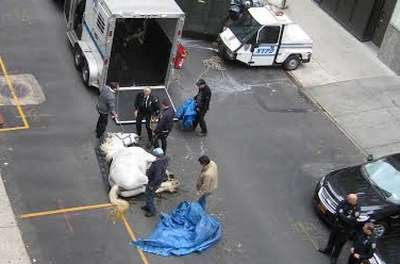
89) September 26, 2013. Carriage horse Chris spooked at Columbus Circle; his carriage swung, smashed into a car, and overturned onto the horse, trapping Chris under the damaged carriage. The carriage driver Frank Luo had been charged the previous day for violations of regulations. Columbus Circle. {4} (Central Park & Environs)88) September 14, 2013. A cab rear-ended a horse-drawn carriage when it stopped suddenly. W. 48th St. & 10th Ave. {85} (Stables & Elsewhere)
87) August 15, 2013. A horse-drawn carriage hit a parked car damaging the car, and left the scene without reporting it. 210 Central Park South. {86} (Central Park & Environs)
86) June 14, 2013. A horse-drawn carriage hit and damaged a bike, and fled. W. 72nd St. & Central Park West. {87} (Central Park & Environs)
85) June 5, 2013. A horse spooked and bolted into traffic after one of the carriage shafts broke. He tried to free himself and his leg was cut badly. 40th St. & 11th Ave. {46} (Stables & Elsewhere)
84) March 23, 2013. A horse pulling a carriage from Central Park spooked and reared up coming out of the park road. Central Park. {5} (Central Park & Environs)
83) February 7, 2013. A horse and carriage struck a woman's vehicle and left the scene. 210 Central Park South, 7th Avenue--Broadway. {79} (Central Park & Environs)
82) January 4, 2013. An exhausted-looking horse pulling carriage #1075, in the cold at the end of the busy holiday season, collapsed coming out of the park, after the driver dropped off his passengers, near 5th Avenue onto 59th St. {6} (Central Park & Environs)
81) December 8, 2012. A horse pulling carriage #1066 with six people got stuck between cars on 6th Avenue at 51st/52nd Street. The horse spooked, bolted, and ran two blocks. The driver jumped off. Passengers screamed for help, and a running bystander was able to pull a young boy from the carriage. The horse tried to run over some cars, but stopped when he couldn't get beyond cars stopped for a light. 6th Ave. at 51st/52nd. {47} (Stables & Elsewhere)
80) December 3, 2012. A white Audi car was struck by a horse-drawn carriage that left the scene. NE corner 8th Ave. & W. 56th St. {80} (Stables & Elsewhere)
79) November 12, 2012. 7-year-old carriage horse Henry, carrying a driver and three passengers, stumbled and fell near Tavern on the Green in Central Park, hurting his leg. In Central Park at W. 67th St. {7} (Central Park & Environs)
78) November 10, 2012. As a passenger was exiting a taxi by the rear door, a horse-drawn carriage struck the door, causing damage to the vehicle. The carriage driver fled the scene (hit and run). NE corner of 5th Ave. & and E. 47th St. {81} (Stables & Elsewhere)
77) October 2, 2012. A carriage horse spooked and bolted on 11th Avenue in the West 40's. {48} (Stables & Elsewhere)
76) September 20, 2012. A horse spooked on 11th Avenue and 49th Street, slightly injuring himself. The carriage was damaged. 11th Ave. &a 49th St. {49} (Stables & Elsewhere)
75) August 16, 2012. Oreo spooked and bolted with passengers, four injured. With the park and Columbus Circle jammed with people, Oreo spooked due to noise on the hack line at Central Park South, throwing his driver, who landed in the street, his leg bleeding. Oreo bolted with passengers in the carriage, charging in terror, colliding with a double-parked BMW at 60th and Broadway, where his two passengers were thrown from the carriage and injured, and then hitting another car and shedding the remains of the wrecked carriage, he ran free to 57th St. and 9th Avenue, where Oreo collapsed, tranquilized by police. In addition to the driver (hospitalized at Bellevue with 26 stitches) and two passengers (taken to hospital, one in a neck brace, strapped to a board), a police officer pursuing Oreo was also hurt and treated at Roosevelt Hospital. Oreo was pulled from the industry and adopted by a member of the public. Spooked from Central Park to Columbus Circle to 57th St. & 9th Ave. {8} and {8b} and p. 650. (Central Park & Environs)
74) June 19, 2012. A horse-drawn carriage hit a car and broke the back window. The carriage fled the scene. SW corner Broadway & Columbus Circle. {88} (Central Park & Environs)
73) June 15, 2012. An accident involving a motor vehicle and a horse-drawn carriage took place. The carriage driver refused information and fled the scene. NW corner 7th Ave. & W. 55th Street. {89} (Stables & Elsewhere)
72) June 7, 2012. 12-year-old mare Doreen sustained a bleeding gash to her face when an SUV hit her carriage and a motorcycle, and she was smacked by the SUV, her head cracking the windshield. The police reported a 24 year old man "fell off a horse, bleeding from the knee." Columbus Circle. {9} and p. 650. (Central Park & Environs)
71) March 3, 2012. A horse, returning to the stable, spooked on 11th Avenue and 52nd Street, and bolted into congested traffic, dragging his empty, overturned carriage into the street in tow. The horse finally fell to the ground outside The Daily Show studio on 11th Avenue, south of 52nd Street. The horse appeared to be shaking and frightened. 11th Ave. & 52nd St. {50} (Stables & Elsewhere)
70) February 14, 2012. A carriage horse injured his leg on Valentine's Day, one of the times when carriage horses are worked the hardest. Central Park. {10} (Central Park & Environs)
69) December 4, 2011. Flash, pulling a carriage with three adults and a child, collapsed on the street at the start of the holiday season. Grand Army Plaza at 59th St. & 5th Ave. {11} (Central Park & Environs)
68) November 4, 2011. Carriage horse Luke fell to the ground while pulling a carriage during rush hour. 60th St. & Broadway. {12} (Central Park & Environs)
67) October 28, 2011. A horse unattended on the hack line on Central Park South near Columbus Circle spooked and bolted at top speed into traffic, made a U-turn, ran back into the park at 7th Avenue, skid, hit the curb, flipped with the carriage, falling to his side, got up, ran into the park again, crashed again into the curb, and stood, still tangled and trapped in the harness of his overturned, wrecked empty carriage at West & Center Drive. The horse is no longer in the industry. Central Park. {13} (Central Park & Environs)
66) October 23, 2011. CHARLIE DIES. Magnificent Percheron Charlie collapsed and died in the street en route to work, on West 54th Street between 8th and 9th Avenues. Charlie was found to be suffering from a gastric ulcer. Lack of turn out to pasture and lack of forage, and the natural and full life that goes with it, combined with stress, can quickly bring on gastric ulcers in horses. W. 54th between 8th & 9th Aves. {51} (Stables & Elsewhere)
65) October 4, 2011. A horse-drawn carriage struck a moving vehicle causing damage, and fled the scene. NW corner 8th Ave. & W. 58th St. {90} (Stables & Elsewhere)
64) End of July, 2011. A horse spooked and fell while pulling tourists in Central Park. Frightened, the passengers jumped out of the carriage. The driver made the horse go back to work. Central Park. {14} (Central Park & Environs)
63) July 25, 2011. A taxi rear-ended a horse-drawn carriage on Central Park South, throwing a woman passenger onto the sidewalk bleeding, and the carriage knocked the horse to the street, overturning on top of the horse, who later managed to get back on his feet, with bleeding cuts. The three passengers and the driver were injured, the driver in critical condition with a bleeding head injury. Central Park South. {15} (Central Park & Environs)
62) July 16, 2011. A carriage horse spooked and bolted, galloping out of control from Grand Army Plaza & 5th Avenue up Central Park South to 7th Avenue, hitting a taxi and a car on the way. Grand Army Plaza to Central Park South & 7th Ave. {16} (Central Park & Environs)
61) June 16, 2011. A horse-drawn carriage struck a truck, causing damage to the side of the truck, and fled the scene. SE corner 11th Ave. & W. 56th St. {91} (Stables & Elsewhere)
60) May 12, 2011. A horse-drawn carriage struck a delivery man riding his bike, causing the man to fall off the bike, hurting his ankle and breaking the bike. NE corner W. 54th St. & 11th Ave. {82} (Stables & Elsewhere)
59) November 3, 2010. A bus grazed a carriage horse on 7th Avenue near 54th Street at 5:30 p.m., rush hour, when carriages are prohibited in the area. A witness stated the horse "was spooked and evidently frightened out of his or her wits." 7th Ave. near 54th St. {52} (Stables & Elsewhere)
58) May 11, 2010. A carriage horse collided with a taxi in Central Park. {17} (Central Park & Environs)
57) May 1, 2010. A horse pulling a carriage spooked and ran into oncoming traffic, sideswiping cars, at Central Park South and Columbus Circle. {18} (Central Park & Environs)
56) April 15, 2010. A horse-drawn carriage sideswiped a moving car and left the scene. NW corner Broadway & Central Park South. {92} (Central Park & Environs)
55) April 1, 2010. A man was unloading packages from his parked vehicle, when a horse-drawn carriage struck the vehicle, causing damage, and left the scene. Ninth Ave. & W. 58th St. {93} (Stables & Elsewhere)
54) March 30, 2010. A horse-drawn carriage hit the right side of a moving car causing damage to side mirror, and left the scene. NE corner 8th Ave. & W. 53rd St. {94} (Stables & Elsewhere)
53) January 5, 2010. A horse-carriage collided with a vehicle, throwing the carriage driver who lay unmoving on the ground, with EMS en route. The spooked and panicked carriage horse broke free, ran toward 59th Street, colliding with at least two parked cabs, kicking, and possibly injuring or even breaking a leg. W. 60th St. & Columbus Avenue. {83} (Central Park & Environs)
52) November 23, 2009. A 6-year-old child fell out of a horse-drawn carriage in which his family was riding, and was run over by the wheel, resulting in stomach, chest, and head injuries; the child was rushed to New York Presbyterian Hospital. 63rd St. & Center Drive. {84} (Central Park & Environs)
51) October 21, 2009. A horse-drawn carriage hit a moving car and fled the scene. SW corner Avenue of the Americas & Central Park South. {95} (Central Park & Environs)
50) September 19, 2009. A taxi turning into Grand Army Plaza plowed into a parked carriage, which had just dropped off passengers, at 60th Street and 5th Avenue, knocking it over and smashing it, and then crashed into the stone wall surrounding the park. Blackie the horse, free of the totaled carriage, bolted for a couple of blocks. The carriage driver appeared "seriously injured," and both drivers were hospitalized. 60th St. & 5th Ave. at Grand Army Plaza, Central Park. {19} (Central Park & Environs)
49) September, 2009. HORSE DIES. A carriage horse caught his foot on a parking meter and had to be euthanized. (Source: Then New York Governor David Paterson, December 15, 2009) {53} (Stables & Elsewhere)
48) February 7, 2008. CLANCY DIES. Clancy, an eight-year-old Percheron, was found dead at the Clinton Park stables at 618 W. 52nd Street. Clancy reportedly had not worked since February 2 and was being treated by a licensed veterinarian. When the ASPCA (then responsible for monitoring carriage horse welfare) requested Clancy's veterinary records, to determine whether neglect or abuse were a factor, for the first time the Department of Health refused them, and told them to FOIL the records. (Freedom of Information Law.) As Clancy was a young horse, it is speculated that his cause of death may have been colic caused by poor diet and overwork; but Clancy's cause of death remains unknown. Stables, 11th Ave. near 52nd St. {54} (Stables & Elsewhere)
47) September 14, 2007. SMOOTHIE DIES. 12-year-old mare Smoothie was spooked on the hack line when a performer from a break-dance troupe walked by the horses beating a small drum. Smoothie reared up, ran onto the sidewalk and between two trees about 2 feet apart--she could pass, but her carriage couldn't, and as she tried to lunge forward in panic, she collapsed and died on the sidewalk. Her panic caused a second horse, also attached to a carriage, to dart into traffic and leap on the hood of a Mercedes-Benz with passengers inside. 50 Central Park South between 5th & 6th Aves. {20} (Central Park & Environs)
46) July 4, 2007. 12-year-old carriage horse Bud spooked on Central Park South and collided with a taxi, suffering several gashes on his rear legs. The taxi driver was treated for injuries at New York Hospital, and his cab suffered significant damage. A motorcyclist's bike was hit with the carriage and trampled, as the biker tried to leap out of the way. Central Park South. {21} (Central Park & Environs)
45) June 2, 2007. A spooked young horse harnessed to a carriage, with the driver running behind, galloped into traffic, and was hit by an SUV at 54th Street and 7th Avenue, knocking loose the carriage onto the sidewalk, barely missing pedestrians. The horse fell to the pavement, but later rose, dazed and limping. 54th St. & 7th Ave. {55} (Stables & Elsewhere)
44) April 13, 2007. A taxi crashed into a carriage while the horse was working. The horse was walked back to the stable. Central Park South at Grand Army Plaza. {22} (Central Park & Environs)
43) September 15, 2006. JULIET DIES. Juliet collapsed in Central Park. Her driver began to beat her with a whip on his veterinarian's orders, he said, believing she had colic, to try to get her to stand and walk to rid herself of gas and toxins. But she could not stand; Juliet rose and collapsed several times. She was trailered to the stable and died there hours later, reportedly from rhabdomyolysis or "Tying up disease." Juliet was a lovely Percharon/American draft cross in her 20's, who had been pulling carriages for at least 17 years. Central Park. {23} (Central Park & Environs)
42) May 5, 2006. A spooked horse pulling a carriage from Shamrock Stable ran through the street narrowly missing several cars before colliding with and overturning a moving car, which was badly damaged. The horse tumbled, then staggered back up, and witnesses observed a gash on the horse's neck. The driver of the car was hospitalized with wounded hands. W. 46th St. & 11th Ave. {56} (Stables & Elsewhere)
41) April 28, 2006. A young carriage horse on a training run spooked and ran wild in Central Park crashing into a 71-year-old bicyclist who was seriously injured and suffered a dislocated leg. The driver of the empty carriage had lost control of the horse and leapt from the carriage injuring his knee. The horse had jumped off East Drive and galloped near 67th St. before continuing west to collide with the bicyclist at 64th St. & Central Drive. The bicyclist and carriage driver were both hospitalized. 64th St. & Central Drive. {24} (Central Park & Environs)
40) January 2, 2006. SPOTTY DIES. 5-year-old gelding Spotty, in the carriage business only a few months, returning to Westside Stables, spooked in traffic near the Lincoln Tunnel and bolted down 9th Avenue. He collided with a station wagon at 50th Street, and was pinned underneath for half an hour, head on the ground, legs on the roof. Spotty suffered a broken leg. He was terrified and resistant as he was led away, bucking and kicking, very afraid, and he was euthanized that day. His driver, who had only eight months experience with horses, was thrown from the cab and hospitalized in a coma, critically injured with a fractured skull. The station wagon passengers suffered minor injuries. 50th St. & 9th Ave. {57} (Stables & Elsewhere)
39) May 13, 2005. Two horses from Chateau Stables galloped through the streets after their carriage was rear-ended by a van. The carriage flipped over and freed them around 14th Street and 8th Avenue; the carriage driver was thrown and landed on his head. Police later caught the horses. 14th St. & 8th Ave. {58} (Stables & Elsewhere)
38) October 24, 2003. Two horses spooked, tipping their carriages, and four people were injured. At 5th Avenue and 61st Street, a carriage horse startled and reared up, tipping the carriage and dumping two female tourists and the driver. Another driver came to help, and his horse also spooked and tipped that carriage in turn, hurting a female passenger. The three passengers and first driver were taken to hospital for treatment. 5th Ave. & 61st St. {25} (Central Park & Environs)
37) January 22, 2002. A horse pulling a carriage spooked and bolted at 10th Avenue and 56th Street. His carriage got wedged between two cars, and he was so unnerved that he needed to be tranquilized. It took several people to free him. A few cars were damaged. 10th Ave. & 56th St. {59} (Stables & Elsewhere)
36) November 26, 2001. A taxi cab collided with a horse-drawn carriage in the southern end of Central Park, startling the horse and injuring the carriage driver. Central Park. {26} (Central Park & Environs)
35) November 9, 2000. A horse broke free of the carriage, bolted, and collided with a car while galloping down the street. The horse tripped and fell to the ground, injuring a leg. Chelsea. {60} (Stables & Elsewhere)
34) November 2, 2000. A horse broke free from her carriage at Columbus Circle and hit at least one car as she galloped to Broadway, stopping morning traffic as people watched in horror. The horse went about half-a-block before the harness broke, entangling the horse and tripping her. The horse fell and slid down the street. Columbus Circle/Broadway. {27} (Central Park & Environs)
33) September 5, 2000. A runaway carriage horse broke free from his driver at W. 59th Street and Central Park South, and ran headlong through the streets of Manhattan. Police moved pedestrians and drivers out of the horse's path until they blocked his escape at W. 72nd Street and Central Park West. Central Park. {28} (Central Park & Environs)
32) August 27, 2000. Turning a narrow corner in Central Park, the shaft dug into the horse's side, panicking the horse, who tried to run, slamming the carriage over on its side and injuring a vacationing British family of four in a "harrowing tumble." The horse then took off through the park heading straight for a hot dog vendor who had to jump out of the way. The tourists were strapped to backboards and taken to hospital for minor injuries. "We're animal lovers, so we were delighted that the horse wasn't hurt," said the Mum. "But we're not having any more of those rides." Just inside Central Park at Central Park South/Avenue of the Americas entrance. {29} (Central Park & Environs)
31) April 27, 2000. A carriage horse, Rocky, broke loose from his midtown stable. Narrowly missing being hit by a bus, he turned onto Tenth Avenue, creating havoc as drivers slammed on their brakes to avoid hitting him. Rocky headed for a traffic agent who had her back to him. "If I had stood there for another second, he would have killed me," she said. Rocky was eventually corralled by Craig Rivera, brother of Geraldo, cutting him off in his Volvo. Tenth Avenue. {61} (Stables & Elsewhere)
30) August 5, 1999. A runaway horse and carriage struck a car, jumped the sidewalk, and knocked down a 70-year-old man and a 68-year-old woman at 9th Avenue and 51st Street. The woman was pinned under the horse's rear hoof and was treated for minor injuries. The man needed a hip replacement because of the fall. 9th Ave. & 51st St. {62} (Stables & Elsewhere)
29) July 1, 1999. A horse spooked and the carriage struck two parked cars before the horse galloped into another car. Chelsea. {63} (Stables & Elsewhere)
28) June 28, 1999. A hit-and-run driver smacked into a horse-drawn carriage at Central Park West and 69th Street, throwing the carriage driver onto the street and shattering her jawbone, and sending her spooked horse galloping north on Central Park West. "The gelding's wild run ended when he bolted into the southbound lane and was hit by an oncoming car." Miraculously, neither horse nor car driver was injured. The carriage driver went to hospital. Central Park West. {30} (Central Park & Environs)
27) June 21, 1999. A carriage horse was startled and threw his driver on Central Park West and 57th Street. A second carriage driver tried to stop the runaway horse but failed, sustaining minor injuries. The horse got stuck between a parked car and a yellow cab, which hit the horse. The yellow cab driver was injured and hospitalized with head and neck injuries. The horse's condition is unknown. Central Park West & 57th Street. {31} (Central Park & Environs)
26) January 8, 1999. JACKIE DIES. Only 7-years-old, gentle dapple-grey Jackie collapsed and died, electrocuted, when she stepped on a steel Con Edison service box on East 59th Street between Park and Madison Avenues. The wet weather, a short circuit, and her metal horse shoes caused her death. The driver suffered minor injuries. E. 59th between Madison and Park Aves. {32} (Central Park & Environs)
25) April 29, 1998. HORSE DIES. A horse broke his halter, ran into a busy street, and was killed by an oncoming car. The driver of the car was treated for back injuries. Location unknown. {64} (Location unknown)
24) January 13, 1998. A runaway horse, Nicky, pulling a carriage sent scores of Times Square strollers fleeing for their lives. Two passengers jumped from the careening carriage seconds before it flipped into a light pole and broke apart at 7th Avenue and 42nd Street; the passengers were taken to hospital. Nicky was headed toward a hotel entrance when the carriage flipped. Times Square. {65} (Stables & Elsewhere)
23) November 23, 1997. A runaway horse pulling a carriage bolted at Broadway and Central Park South, banged into a Ford and bounded onto the sidewalk at Avenue of the Americas and Central Park South, running over a tourist who was knocked to the ground and dragged a few feet. She was hospitalized. The carriage driver took off with the horse, who was in shock, but the driver was later issued a summons by police for leaving the scene. Central Park South. {33} (Central Park & Environs)
22) September 4, 1997. Horses pulling two carriages were spooked by a passing car. An elderly woman was seriously injured and eight other people hurt. Location Unknown. {66} (Location Unknown)
21) May 1, 1997. HORSE DIES. A horse pulling a carriage on 49th Street between 7th and 8th Avenues tripped, then died as he struggled to get up. 49th St. between 7th & 8th Aves. {67} (Stables & Elsewhere)
20) September 2, 1996. HORSE DIES. A 10 to 12-year old horse pulling a carriage collapsed on the street and died in front of the Ritz-Carlton New York, Central Park, then known as the Hotel St. Moritz, at 50 Central Park South, on the east side of 6th Avenue. Ritz-Carlton, 50 Central Park South. {34} (Central Park & Environs)
19) May 6, 1994. HORSE DIES. Another horse collapsed and died. Diagnosis indicated tying up syndrome, an extreme cramping of the rear legs, indicating poor horse management (poor feeding routines, lack of water, inadequate medical attention and stabling practices). Location Unknown. {68} (Location Unknown)
18) April 21, 1994. HORSE DIES. A horse had to be euthanized after collapsing in Central Park. Three observers thought the horse had been hit by a cab, but another said the cause was severe cramps from "tying-up syndrome" that can cause collapse of the rear legs, brought on by dehydration and poor dietary management. Central Park. {35} (Central Park & Environs)
17) August 26, 1991. NICKELS DIES. Nickels was euthanized by a veterinarian near the entrance to the Central Park Zoo, after developing crippling leg pain, due to "tying-up syndrome," caused by poor horse management (poor feeding routines, lack of water, inadequate medical attention and stabling practices). Near Central Park Zoo. {36} (Central Park & Environs)
16) August 12, 1991 (approximately). HORSE DIES. Owned by the same owner as Nickels, newspapers reported that this horse died two weeks before Nickels, also in Central Park. While Newsweek speculated that colic may have caused both deaths, tying-up syndrome fits Nickels' symptoms more closely, and so may have caused the death of this horse also. Central Park. {37} (Central Park & Environs)
15) May 15, 1990. TONY DIES. Tony, pulling a carriage, was repeatedly hit by a bus; locked in traffic, he could not escape. The driver of the carriage behind Tony deposed: "The bus started to overtake them...weaved in and out of the right lane, got too close and struck the horse's head with its right side...The bus continued to move as the horse continued to get struck and finally went down, losing [his] footing in the asphalt, until [he] spooked, screamed and fell to [his] death under the bus." She added that the bus appeared to be "playing" with the carriage. 10th Avenue. {69} (Stables & Elsewhere)
14) May 1990. An accident involving an unattended horse at Grand Army Plaza resulted in four wrecked yellow cabs and a hospitalized cab driver. Grand Army Plaza and beyond. {40} (Central Park & Environs)
13) May, 1990. A horse panicked and spooked, due to faulty harnessing, ending in a wild police chase to stop the horse. Location unknown. {39} (Location Unknown)
12) August 15, 1988. WHITEY collapsed of heat stroke and dehydration in 90 degree heat at 62nd Street and 2nd Avenue in "hot, steamy weather." 8-year-old light-grey gelding Whitey from Shamrock Stables struggled to rise for more than two hours on NYC's 200 + degree pavement, and following on Misty's death (see below), Whitey's struggle was telecast around the world, provoking outrage. (The law still permits carriage horses to work in 90 degree heat, without regard to humidity.) Whitey was given IV saline solution, hosed with cool water for two hours, given painkillers, and later bathed in mayonnaise to rid his body of tar picked up lying in the street. With the world watching, the ASPCA ruled that Whitey rest for a month at a bucolic New Jersey farm--but then he was brought back to work in the city. Again, following on Misty's death, people were outraged. A Daily News editorial read, "If torturing an animal on Fifth Avenue is a tourist attraction, the tourists must be Ostrogoths, Visigoths, and Huns." But the Mayor--Mayor Koch--only proposed putting hats on horses to prevent heat stroke. 62nd St. & 2nd Ave. {71} (Stables & Elsewhere)
11) August 7, 1988. MISTY DIES. A week before Whitey's collapse, 6-year-old mare Misty collapsed and died of heat stroke, heat exhaustion, and dehydration from heat and high humidity. Then, as now, there was no humidity limit for when the carriage horses could work. The West Side near 12th Avenue. {70} (Stables & Elsewhere)
10) May 23, 1988. A horse pulling a carriage fell into a manhole. Location Unknown. {72} (Location Unknown)
9) November 9, 1986. Frightened by a passing car, a horse took off down the street, crashing into a building. Location Unknown. {73} (Location Unknown)
8) December 9, 1985. CHESTER DIES. Chester spooked--either his carriage was sideswiped, or a carriage behind them was hit by a speeding car. Chester bolted down the block and collided with a limousine at Rockefeller Center, landing on the hood, smashing the windshield. Chester fell beneath the car, broke his leg, and was euthanized. Chester belonged to Chateau Stables on W. 48th, where he "had a quiet disposition that you can train. We used him to train other horses." Four elderly female tourists--retired schoolteachers from Boston--were thrown out of the carriage and injured. They all returned home in wheelchairs and slings, one woman going blind in one eye due to severe head trauma. There was no compensation to be had for medical costs, which they couldn't afford. Rockefeller Center. {74} (Stables & Elsewhere)
7) December 9, 1985. [A different incident on same date.] Another carriage horse broke loose from her handler at 48th Street and Broadway and galloped toward her stable before being corralled by police at 12th Avenue and 48th Street. 48th St., Broadway to 12th Avenue. {75} (Stables & Elsewhere)
6) December, 1983. (Exact date unknown). DENNIS DIES. Dennis died at Westside Livery Stables of overwork and poor nutrition at the holiday season. “One former driver resigned due to the abuse she witnessed during the holiday season, when drivers up the ante…Her horse Dennis had been overworked to the point where his legs were wobbly. But the owner [of the stable], oblivious to the horse’s condition, insisted he keep working, without a rest break, during a nine-hour day. When they finally returned to the stables, the horse was shivering and frothing at the mouth. But the driver was told to report promptly the next morning at 8 A.M., to take the same horse out again, or she would lose her carriage. Days after she quit, she learned her horse had died. ‘Horses are fed only oats, the cheapest we can find,’ she attested. No fresh fruit or vegetables are offered to the carriage horses unless individual drivers bring their own. Horses are herbivores and need variation in their diets or they can develop colic (acute spasms and abdominal pain) which can lead to death.” Westside Livery Stables, 538 W. 38th St., between 10th & 11th Avenues. {38a} (Stables & Elsewhere)
5) December 31, 1982. A carriage horse frightened by New Year's Eve fireworks charged into a "tidal wave" of densely packed runners at the 10th annual Road Runners Midnight Run on Central Park's West Drive, injuring 13 people in the screaming melee (including broken bones and at least one concussion) and knocking down dozens of others, still others trampling and tripping over the fallen. The injured were rushed to hospitals. The horse was finally stopped unhurt in the middle of West Drive at 70th Street. West Drive, Central Park. {41} (Central Park & Environs)
4) August 4, 1982. MAGGIO DIES. 12-year old bay gelding collapsed and died at the Central Park South park entrance.
{4a} (Central Park & Environs)
3) July 18, 1982. HORSE DIES. A carriage horse collapsed and died in the street while working, due to heat and humidity. Indeed, on this terrible day, three carriage horses died from the heat and humidity in the streets of New York. The high that day was 98 degrees. Location Unknown. {76} (Location Unknown)
2) July 18, 1982. HORSE DIES. A second carriage horse collapsed and died in the streets while working, due to extreme heat and humidity on the same terrible day. Location Unknown. {77} (Location Unknown)
1) July 18, 1982. HORSE DIES. This is the third of the carriage horses who tragically died in the streets, while working, of high heat and humidity, on July 18, 1982. Location Unknown. {78} (Location Unknown)
SUMMARY OF THE 24 CARRIAGE HORSE DEATHS IN NEW YORK CITY (included in the list above)
Billy, July 20, 2022 - during a heat wave, found dead in his stall, presumably from colic
Tickles, February 13, 2015. Euthanized when mysteriously discovered in stall with fractured leg.
Charlie, October 23, 2011. Collapsed and died, found to have had gastric ulcers and cracked tooth. Gastric ulcers are principally caused by inadequate pasture and stress.
Unnamed Horse, September, 2009. Caught his foot in a parking meter and had to be euthanized.
Clancy, February 7, 2008. Clancy, an eight-year-old, male Draft Percheron, was found dead at the Clinton Park stables on 11th Avenue near 52nd Street at approximately 10 p.m. on Thursday, February 7, according to stable personnel. The horse reportedly had not worked since the previous Saturday, February 2, and was being treated by a licensed veterinarian. When ASPCA agents requested the horse's records from the department of Health, administration officials in an unprecedented manner refused to provide the information and for the first time directed ASPCA agents to file a FOIL request.
Smoothie, September 14, 2007. Spooking accident on the Central Park hack line; Smoothie was spooked by a small drum.
Juliet, September 15, 2006. Juliet, still working into her 20's, after 17 years pulling carriages, collapsed in central Park, possibly of colic, on September 14; she couldn't rise, and was brought back to the stable, where she died the morning of September 15, 2006.
Spotty, January 4, 2006. Spooking accident, collided with a station wagon; euthanized for broken leg.
Jackie, January 8, 1999. Only 7-years-old, Jackie collapsed and died, electrocuted, when she stepped on a steel Con Edison service box cover on E. 59th Street. The wet weather, a short circuit, and her metal horse shoes caused her death.
Unnamed Horse, April 29, 1998. The horse broke his halter, ran into a busy street, and was killed by an oncoming car.
Unnamed Horse, May 1, 1997. Pulling a carriage, the horse tripped, and died while struggling to get up, on 49th Street, between Seventh and Eighth Avenues.
Unnamed Horse, May 6, 1994. The horse collapsed and died; diagnosis indicated poor stable management, believed to be "tying-up syndrome" (extreme cramping of rear legs, which can cause collapse, leading to death).
Unnamed Horse, April 21, 1994. The horse was euthanized when dietary error led to severe cramps and collapse in Central Park. Tying-up syndrome was suspected.
Unnamed Horse, September 2, 1991. The horse collapsed and died outside Hotel St. Moritz (now Ritz-Carlton New York, Central Park).
Unnamed Horse, around August 12, 1991. This horse was owned by the same owner as Nickels. Newspapers reported he died two weeks before Nickels; Newsweek speculated colic may have caused both deaths.
Nickels, August 26, 1991. Nickels was euthanized for crippling leg pain in Central Park.
Tony, May 15, 1990. Tony was trapped in traffic, repeatedly hit by a bus. "The approaching bus was obscured by his blinders until it was upon him."
Misty, August 7, 1988. Misty, a 6-year-old mare, collapsed and died of heat exhaustion, working in hot, humid heat. (Temperature 91 degrees, but very humid.)
Chester, December 9, 1985. Sideswiped in traffic, Chester spooked, bolted down the block, and jumped onto the hood of a car, smashing the windshield, at Rockefeller Center. Chester fell beneath the car, broke his leg, and was euthanized. He was owned by Chateau Stables on W. 48th Street, where it was said that he "had a quiet disposition that you can train. We used him to train other horses." Four elderly passengers spilled from the carriage and were seriously injured.
Dennis, December, 1983 (exact date unknown). Dennis died of overwork and inadequate nutrition during the holiday season.
Maggio, August 4, 1982. Maggio, a 12-year-old bay gelding, collapsed and died at Central Park South.
3 Unnamed Horses, July 18, 1982. On July 18, 1982, three carriage horses collapsed and died in New York streets while working, due to heat and humidity; the high that day was 98 degrees.
++++++++++++++++++++++++++++++++++++++++++++++++++++++++++++++++++++
This was Spotty as he was led away limping, seriously injured in this horrific accident. He was euthanized that night.
|
The Coalition to Ban Horse-Drawn Carriages
P.O. Box 20247 | Park West Station | New York, NY 10025 | Coalition@banhdc.org
|
|
|